
Three years of Rana Plaza Tragedy in Bangladesh
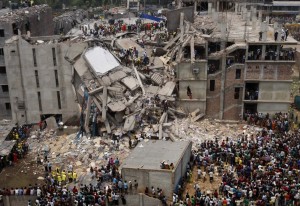
The 2013 Savar building collapse or Rana Plaza collapse was a structural failure that occurred on Wednesday, 24 April 2013 in the Savar Upazila of Dhaka, Bangladesh where an eight-story commercial building named Rana Plaza collapsed. The search for the dead ended on 13 May 2013 with a death toll of 1,130. Approximately 2,500 injured people were rescued from the building alive. It is considered the deadliest garment-factory accident in history, as well as the deadliest accidental structural failure in modern human history.
The building contained clothing factories, a bank, apartments, and several shops. The shops and the bank on the lower floors immediately closed after cracks were discovered in the building. The building’s owners ignored warnings to avoid using the building after cracks had appeared the day before. Garment workers were ordered to return the following day, and the building collapsed during the morning rush-hour.
The building, Rana Plaza, was owned by Sohel Rana, allegedly a leading member of the local Jubo League, the youth wing of the ruling Awami League political party. It housed a number of separate garment factories employing around 5,000 people, several shops, and a bank.
The head of the Bangladesh Fire Service & Civil Defense, Ali Ahmed Khan, said that the upper four floors had been built without a permit. Rana Plaza’s architect, Massood Reza, said the building was planned for shops and offices – but not factories. Other architects stressed the risks involved in placing factories inside a building designed only for shops and offices, noting the structure was potentially not strong enough to bear the weight and vibration of heavy machinery.
On 23 April 2013, a TV channel recorded footage that showed cracks in the Rana Plaza building. Immediately afterward, the building was evacuated, and the shops and the bank on the lower floors were closed. Later in the day, Sohel Rana said to the media that the building was safe and workers should return tomorrow. Managers at Ether Tex threatened to withhold a month’s pay from workers who refused to come to work.
On the morning of 24 April, there was a power outage, and diesel generators on the top floor were started, The building collapsed at about 08:57 a.m leaving only the ground floor intact.The Bangladesh Garment Manufacturers and Exporters Association president confirmed that 3,122 workers were in the building at the time of the collapse. One local resident described the scene as if “an earthquake had struck.
Very early on in the rescue effort, the United Nations offered to send their expert search and rescue unit, known as the International Search and Rescue Advisory Group (INSARAG), to the site, but this offer was rejected by Dhaka authorities. The Bangladesh government made a statement suggesting that the area’s local rescue emergency services were well equipped. Prior to offering assistance to Bangladesh, the UN held consultations to assess the country’s ability to mount an effective rescue operation, and they reached the conclusion that they lacked that capability. Bangladeshi officials, fearing damage to national pride, refused to accept the assistance offered to them by the UN. A large portion of the rescue operation consisted of inadequately equipped volunteers, many of whom had no protective clothing and wore sandals. Some buried workers drank their own urine to survive the high temperatures, waiting to be saved. Not only was the Bangladeshi government accused of favouring national pride over those buried alive, but many relatives of those trapped in the debris criticised the government for trying to end the rescue mission prematurely.
One of the garment manufacturers’ websites indicates that more than half of the victims were women, along with a number of their children who were in nursery facilities within the building. Bangladeshi Home Minister Muhiuddin Khan Alamgir confirmed that fire service personnel, police, and military troops were assisting with the rescue effort. Volunteer rescue workers used bolts of fabric to assist survivors to escape from the building. A national day of mourning was held on 25 April.
On 8 May an army spokesman, Mir Rabbi, said the army’s attempt to recover more bodies from the rubble would continue for at least another week. On 10 May, 17 days after the collapse, a woman named Reshma was found and rescued alive and almost unhurt under the rubble
The direct reasons for the building problems were:
- Building built first without authorization on a pond,
- Conversion from commercial use to industrial use,
- Addition of 4 floors above the original permit
- The use of substandard construction material (which led to an overload of the building structure aggravated by vibrations due to the generators). Those various elements indicated dubious business practices by Sohel Rana and dubious administrative practices in Savar.
One good example to illustrate this context is the evacuation of the building after the cracks. It is reported that the Industrial police first requested the evacuation of the building until an inspection had been conducted. It is reported that Abdur Razak Khan, an engineer, declared the building unsafe and requested public authorities to conduct a more thorough inspection; he was arrested for helping the owner illegally add three floors. It is also reported that Kabir Hossain Sardar, the upazila nirbahi officer visited the site, met with Sohel Rana, and declared the building safe. Sohel Rana said to the media that the building was safe and workers should return to work the next day. One manager of the factories in the Rana Plaza reported that Sohel Rana told them that the building was safe. Managers requested then workers to go back to work, so that on the next day workers entered the factories again.
Based on all the above elements it can be concluded that one cause of the disaster is the lack of good governance in Savar, and corruption. Some have called Sohel Rana “a crooked mobster”.
Three years have passed but the affected people could not get any support from the side of Government. Still they are morn about their relatives.
